
Language
Villatel combines the space of a villa with the operational standards of a hotel: front desk, concierge, security, restaurants, waterpark and villas of 4 to 9 bedrooms with private pools, full kitchens, game rooms and themed bedrooms. RoomChecking helps its teams structure housekeeping, maintenance, inspections and cost tracking across complex, highly customised properties.
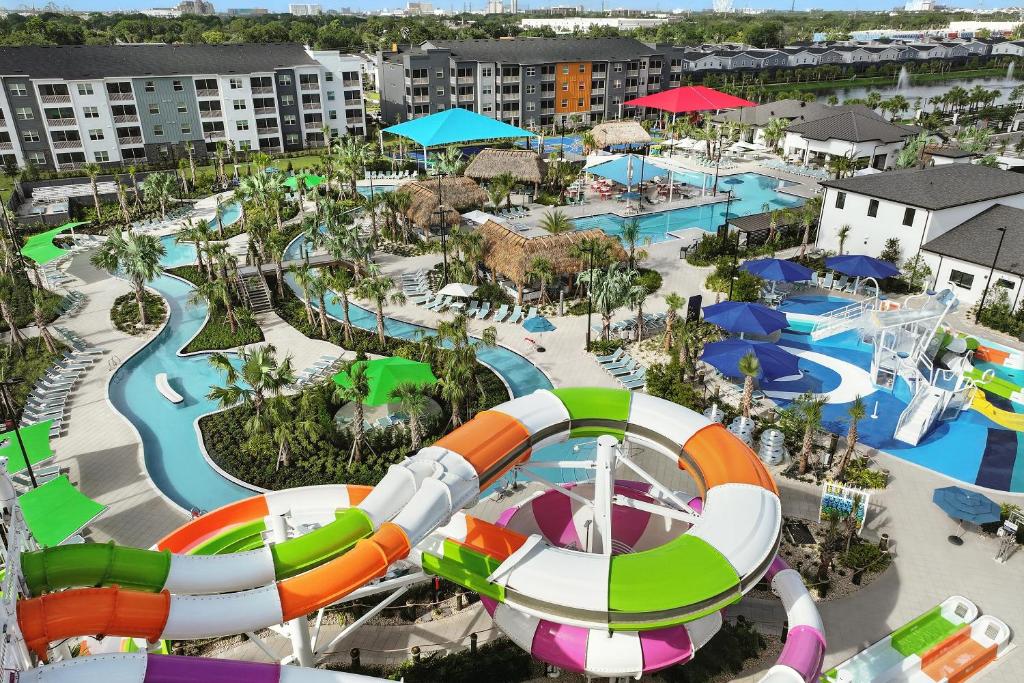
Villatel Orlando Resort is a luxury villa resort designed for families, groups and multi-generational stays. But behind that spectacular experience, the operation is far more complex than a traditional hotel: villas of different sizes, private pools, arcade rooms, multiple assets, spread-out zones and high service standards.
With RoomChecking, Villatel can model every building, villa, zone and sub-space, automate checklists by property type, track housekeeping and maintenance tasks, and connect field operations to cost tracking.
Villatel offers a hybrid experience: the space and freedom of a villa, with the standards and services of a hotel. The concept answers a clear need: hosting families, groups, teams and multi-generational stays in larger accommodation, while keeping a professional level of service.
Villatel Resort Orlando runs on a full hotel model: front desk, concierge, security, restaurants, activities and a waterpark. The accommodation consists of villas with 4 to 9 bedrooms, private pools, full kitchens, game rooms and themed bedrooms, across a portfolio of more than 500 units.
That's a strong commercial promise. Operationally, it creates far more complexity than a standard hotel.
In a traditional hotel, rooms tend to follow repeatable layouts. At Villatel, every villa can have a different configuration: multiple bedrooms, a private pool, an arcade room, kids' areas, a home theatre, a kitchen, outdoor spaces and specific equipment.
That diversity complicates housekeeping, inspections and maintenance. A villa with a pool isn't prepared like a villa without one. A villa with an arcade room needs different checks. A themed bedroom or a cinema space calls for its own checklists.
The challenge was to move beyond a generic “room to clean” logic toward something far more precise: building, zone, villa, sub-space, asset, checklist, cost and ownership.
Without a system built for that, the risk is immediate: forgotten tasks, incomplete inspections, misassigned maintenance, invisible costs and an inconsistent guest experience.
RoomChecking lets Villatel model its properties at a level of granularity that matches reality on the ground.
Every building, floor, zone, villa and sub-space can be configured in RoomChecking. Tasks can then be assigned and tracked precisely: a bedroom, a theatre, a pool, a game room or a specific piece of equipment. That sub-space precision changes what the data can tell you. In villa 202, for instance, bedroom 2 had logged 13 lamp issues against only 2 in bedroom 1 — a gap that points to a structural problem rather than a series of unrelated incidents.
Checklists and workflows are tailored to the villa type. Villas with a pool trigger inspections tied to pool equipment, while villas with an arcade room can trigger checks on consoles and gaming equipment.
RoomChecking also helps teams plan the day. The visual planner auto-dispatches assignments by zone and team availability, while flagging late cleans or villas that have stayed dirty too long. It can also trigger a refresh clean when a villa has gone unrented for six days — a rule a PMS alone cannot handle.
The Villatel case is particularly interesting because it doesn't stop at housekeeping.
RoomChecking also structures maintenance and asset management. Teams can select standardised assets, such as an air conditioning unit, instead of creating free-text tickets that are hard to analyse afterwards.
That structure makes it easier to track repairs, labour costs, supplies, taxes, rebilling parameters and data feeding into financial systems. Costs attach to the room or sub-space concerned: a twenty-minute intervention in villa 202, bedroom 1, can show 20 dollars of labour and 5 dollars of materials, with the assigned technician named.
This is critical for a villa resort: when each property contains dozens of assets, the true operating cost goes well beyond cleaning. It includes wear, repairs, replacements, supplies and the time teams spend on them.
With RoomChecking, Villatel gains operational consistency across its entire villa portfolio.
Teams work from checklists adapted to each property type, which reduces the risk of oversights and keeps the experience more consistent from one villa to the next.
Housekeeping and maintenance tasks are better assigned, better tracked and more visible to managers, with improved accuracy and speed in execution and faster resolution of maintenance issues.
Cost tracking becomes clearer as well. Managers can better judge whether to repair or replace an asset, follow costs per task or per villa, and make better operational decisions.
The Villatel case makes an important point: villa resorts can't be run like standard hotels.
The larger, more customised and more equipment-heavy the accommodation, the more precise the operational system has to be. A generic checklist simply isn't enough.
RoomChecking delivers that precision: space modelling, checklists by villa type, asset tracking, dispatch by zone, alerts, dashboards and a connection to financial data.
The value isn't only time saved. The real value is keeping control of an operation that is complex, spread out and expensive to get wrong.
For Villatel, RoomChecking becomes the operational infrastructure behind a hybrid hospitality model: luxury villas, resort services, customised equipment and high standards.
The platform helps teams organise housekeeping, structure inspections, speed up maintenance, track assets and understand operating costs.
For villa resorts, premium rentals, upscale aparthotels and multi-property operators, RoomChecking offers a direct lever: turn field complexity into a clear, measurable, scalable system.